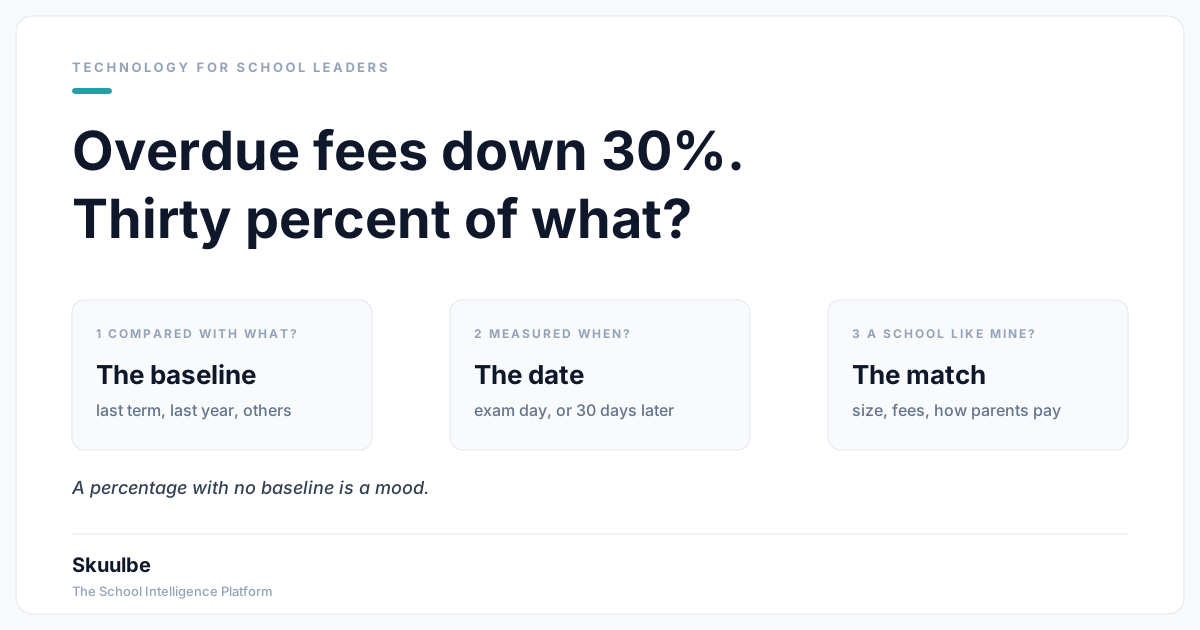
Technology for School Leaders
Ask the Denominator
Anyone selling a way to collect school fees will, sooner or later, show you a number. Overdue fees down by a third. Collection above nine in ten. The numbers may be perfectly honest. They are still a fraction with the bottom half missing.
Mid-term is tomorrow and Term 1 closes on 17 December. If you are thinking about changing how fees are collected for Term 2, this is the week to decide how you will judge what you're told.
What the number leaves out
Here is an invented school, with invented figures, to show the problem. It has 100 pupils and bills GH¢400,000 for the term.
Someone tells you their customers cut overdue fees by 30%. If this school's overdue balance at the end of term was GH¢10,000, a 30% cut is GH¢3,000. The school was already collecting 97.5% of what it billed, and the real money is somewhere else.
Now a second school, same size, with GH¢100,000 overdue. A 30% cut there is GH¢30,000. Same sentence, ten times the money, and neither school learned it from the sentence.
The percentage tells you how large a change was relative to a starting point you weren't shown.
Three questions
Compared with what? Last term? The same term last year? The average of schools that signed up? A school that adopts something new may be a school that has just decided to deal with its arrears, in which case some of the improvement would have come anyway.
Over how long, and measured when? One term or four. At mid-term, at term close, or thirty days after. A balance counted on the last day of exams and one counted six weeks later can differ a great deal, and whoever picks the date picks a good part of the result.
In a school like mine? Enrolment, fee level, and how your parents actually pay: Mobile Money, bank, cash at the gate. An average over fifty schools says little about one school with 200 pupils where most families pay in the first week.
Then one practical request. Ask for a school you can phone, by name, and ask that school the same three questions.
Write your own numbers first
Before you hear the next pitch, take your last two terms and write three figures for each: what you billed, what you had collected at the end of the term, and what was still unpaid thirty days after it closed. That is an hour's work with the fee register.
Those six numbers are the baseline any claim has to beat. Without them you can't tell a good result from a flattering one, and the person making the claim can't be asked to prove anything, because you haven't said what you'd accept.
Some of the claims you hear will be true. The number you were handed may still be unable to show it.
A percentage with no baseline is a mood.