Running a Better School
A Promise Needs Two Names
On 27 October the Education Minister said about 28,000 GES staff were still waiting for promotion arrears and that the 30 October date might not hold. The money was not the problem, he said; the budget provides for it. The records had not been validated, and validation was being done by hand across GES and the Controller and Accountant-General's Department (CAGD). We have found no report of payment since.
CAGD's account, reported by GNA on 16 October, is told from the other side. It had paid 56,003 teachers. Another 630 cases were held up by verification problems, and 23,367 had not been processed because it was waiting for GES to send supporting documents. The Minister's own figures differ: he spoke of 52,000 paid and about 28,000 outstanding, some of them non-teaching staff. We don't know which count is right, and for this piece it doesn't matter.
It also doesn't matter whose fault it is. Both accounts can be true at once. What the teacher sees is a date that was given, a date that passed, and an explanation about a handoff between two offices they can't see into.
You have a smaller version of this in your school. A salary adjustment that waits for the bookkeeper's sheet. A staff loan that waits for a bank letter. An allowance you agreed in a meeting that waits for the board's note to be typed. In a small school the person holding the paper and the person holding the money are rarely the same person, and the promise sits in the gap.
What to do before mid-term
Mid-term break is 5–6 November. Before it, take the page you may already have of promises made to staff, or start one, and go through it for a single question: which of these cannot happen until someone else hands me something?
For each one you find, write two lines.
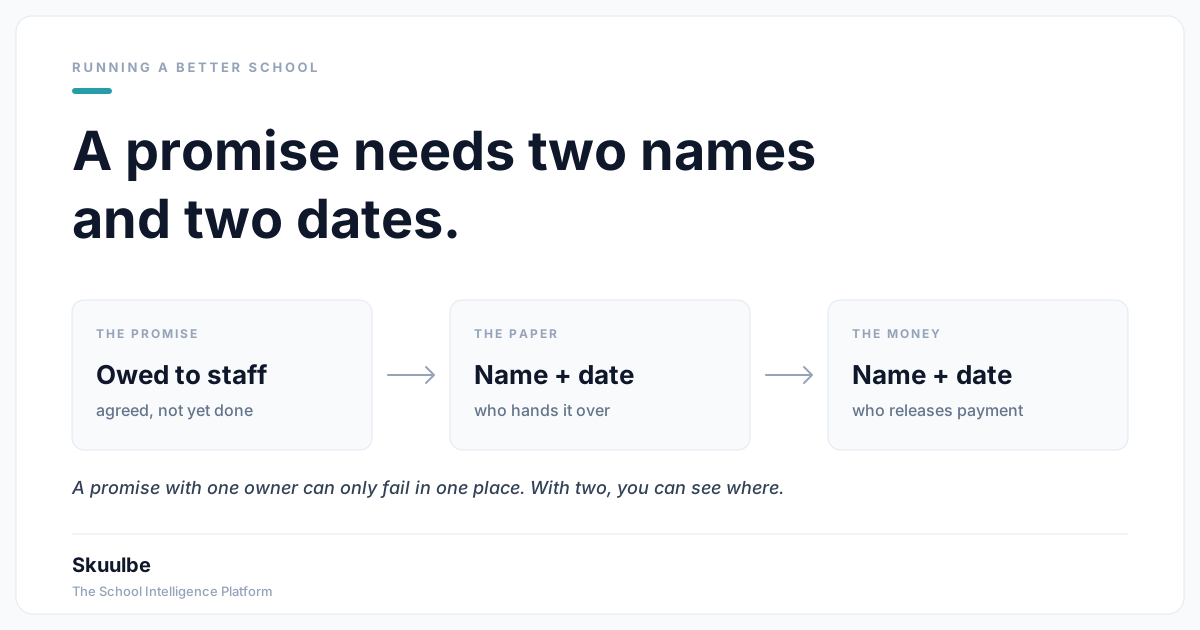
The paper: who has to hand it over (a name, not "accounts"), and by what date.
The money: who releases the payment once it arrives (a name, and if it's you, write your own), and by what date.
Then do the part that costs nothing. Tell the staff member where it stands: "The sheet is with Mr. Mensah, due Thursday. I pay on the Monday after." If the paper hasn't come by its date, tell them that on the day, not the week after.
Why two names
A promise with one owner can only fail in one place, and you won't know where. With two names, a stall shows up at the handoff, which is where this kind of promise usually stalls. The date on the first line is the early warning for the date on the second.
It also changes what you can say to the person waiting. "Soon" asks them to trust you. "The sheet is due Thursday" gives them something to check. Staff forgive a delay they can see coming far more readily than one they discover.
The teacher waiting on arrears doesn't need to know which office is slow. They need a name and a date.